• Grassroots Login
  • Join Now
  • Find St. Croix


Skip to content
  • Home
  • About the Breed
  • About SCHSB
  • News/Events
  • Contact Us
  • Classifieds
  • Shop

Author: Treasurer Treasurer

How to Record Sheep Deaths in Grassroots

Posted on October 21, 2023January 23, 2024 by Treasurer Treasurer
How to Record Sheep Deaths in Grassroots

This article will teach you how to record deaths of sheep on the Grassroots system. This process is very easy to do. It’s important to clear out sheep that have died or been butchered. Doing so means that you will have an accurate list of sheep available. This makes it much easier to select sheep for breeding, to list for sale, or to perform a check mate. Don’t worry, those sheep will not disappear from the database. You can still find them using the search feature, and they will appear in the pedigrees of their offspring.

Also, keeping your flock list up to date makes it possible for SCHSB to get a more accurate estimate of the number of active sheep in our database. This is extremely important to ensure that the population isn’t falling to levels that would demand further conservation efforts.

The good news is that it’s super easy to record sheep deaths. Spend a little time reviewing your records and then clean up your flock list!

Steps to record sheep deaths:

  1. Log in to the Grassroots System.
  2. Click the pancake stack on the upper right corner of your dashboard.
  3. Click Deaths.
  4. Tick the box next to any sheep that is deceased.
  5. Click the orange Next button.
  6. Check your list, then click the orange Submit button.

That’s it! If you need help, contact us. Please note that it can take up to 14 days for processing, during which time those deceased sheep may seem to be invisible. We promise, they are still there!

Here is a video that walks you through recording deaths:

Learn how to use all the features of the Grassroots System by attending our Annual Meeting on October 28th, or by subscribing to our YouTube channel and watching the How to Use the SCHSB Registry System playlist.

Posted in FAQ, Using Grassroots Tagged deaths, Grassroots, records, registrar

How to Birth-Notify Your Lambs

Posted on October 20, 2023January 23, 2024 by Treasurer Treasurer
How to Birth-Notify Your Lambs

This article will teach you how to record you lambs, a process called birth-notify, on the Grassroots system. This is a new process for us, because our old system only allowed us to record lambs when we registered them. Most of us probably record birth information for our lambs when they are born or soon after using a notebook, spreadsheet, or software. We decide later which ones to register, and in our old system, this is when we would finally go to the computer.

The birth-notify feature allows our members to record this information in the system with no transaction fee, rather than on paper, in a spreadsheet, or in separate software. Members can still decide later which lambs to register and then pay the fees. You can also register and transfer simultaneously.

While members can still follow the same procedure of only entering the lambs you’ve decided to register, there are several benefits to recording all lambs, even those left unregistered. First, you can tag those birth-notified sheep for sale in the system, so you can sell them as unregistered if desired, and their pedigrees are still visible and searchable. Second, by recording all lambs, your ewes’ production records will be more accurate, and you can easily share them with potential customers. Finally, by recording lambs earlier, you are less likely to mix up lambs later. That means you avoid parentage issues.

The good news is that it’s super easy to birth-notify your sheep and it’s a free benefit for our members. If you have lambs on the ground now, you should get started now!

Steps to birth-notify your lambs:

  1. Log in to the Grassroots System.
  2. Click the pancake stack on the upper right corner of your dashboard.
  3. Click Births.
  4. Fill in the birth information (date of birth, conception type, number born, etc.).
  5. Select the sire and dam from your flock, or search for them in the system if they are owned by another member. If you rented a ram or purchased bred ewes, you must send in a breeding certificate before you can register the lambs.
  6. Decide if you want to log all births from this lambing or not. You are not required to do so, but we recommend that you do.
  7. Click the orange Next button.
  8. Fill in the information for each lamb you wish to birth-notify. All fields are required except Alt. No., Individual Name, Weight, and Scrapie. We strongly suggest you include an accurate weight if known.
  9. Select the transaction you wish to use. You can Notify for free, register for $8.00, or register & transfer for $16.00.
  10. Click the orange Add To List button.
  11. Check your list, then click the orange Next button.
  12. Tick box to acknowledge the declaration statement, then click the orange Submit button.
  13. If you chose to only notify lambs, you are done!
  14. If you chose to register any lambs, select your method of payment. We strongly suggest you use Paypal to complete payment immediately.

That’s it! If you need help, contact us. Please note that it can take up to 14 days for your birth-notified lambs to appear in your list of sheep.

Here is a video that walks you through birth-notifying your lambs:

Learn how to use all the features of the Grassroots System by attending our Annual Meeting on October 28th, or by subscribing to our YouTube channel and watching the How to Use the SCHSB Registry System playlist.

Posted in FAQ, Using Grassroots Tagged birth-notify, births, Grassroots, lambing, records, registration

How to List Sheep for Sale on Grassroots

Posted on October 19, 2023January 23, 2024 by Treasurer Treasurer
How to List Sheep for Sale on Grassroots

This article will teach you how to list sheep for sale on the Grassroots system. This process replaces the old “Classifieds” section of our website. We all know how useful it is to list our sheep for sale in a place where people are looking specifically for St. Croix sheep. SCHSB’s new registry system offers even more functionality, because potential buyers can look at the pedigrees of the specific sheep you are offering for sale.

The good news is that it’s super easy to list sheep for sale and it’s a free benefit for our members. If you have sheep you want to sell, you should follow these steps right now!

Steps to list sheep for sale:

  1. Log in to the Grassroots System.
  2. Click the pancake stack on the upper right corner of your dashboard.
  3. Click Flag Animals for Sale/Hire/AI.
  4. Tick the box in the Sale column for each animal you wish to sell.
  5. Click the orange Next button.
  6. Check your list, then click the orange Submit button.

That’s it! If you need help, contact us.

Here is a video that walks you through listing your sheep for sale:

Learn how to use all the features of the Grassroots System by attending our Annual Meeting on October 28th, or by subscribing to our YouTube channel and watching the How to Use the SCHSB Registry System playlist.

Posted in FAQ, Using Grassroots Tagged Grassroots, registry, sale, selling sheep

How to Help People Find Your Farm on Grassroots

Posted on October 19, 2023January 23, 2024 by Treasurer Treasurer
How to Help People Find Your Farm on Grassroots

This article will teach you how to help people find your farm on the Grassroots system. When the system went live, member information was set to private. Unfortunately, that makes it hard for people to find and contact breeders. We all know how useful this feature is. It’s like free advertising to people looking for our St. Croix sheep.

The good news is that it’s super easy to update your Data Protection settings. You should do it right now! You will be sure to sell your sheep much easier if you allow people to see at least some of your contact information.

Steps to help people find your farm:

  1. Log in to the Grassroots System.
  2. Click the orange Manage button.
  3. Confirm that all your contact information is correct. If not, please update it.
  4. Click the dropdown in the Data Protection field.
  5. Select the amount of data you want to be visible. If you don’t want to allow people to see everything, you should at least allow them to see an email, website address, or phone number. Otherwise, they won’t know how to contact you.
  6. If you need help, contact us.

Here is a video that walks you through helping people find your farm:

Learn how to use all the features of the Grassroots System by attending our Annual Meeting on October 28th, or by subscribing to our YouTube channel and watching the How to Use the SCHSB Registry System playlist.

Posted in FAQ, Using Grassroots Tagged data protection, Grassroots, privacy, registry

2023 Virtual Annual Meeting

Posted on October 4, 2023October 4, 2023 by Treasurer Treasurer
2023 Virtual Annual Meeting

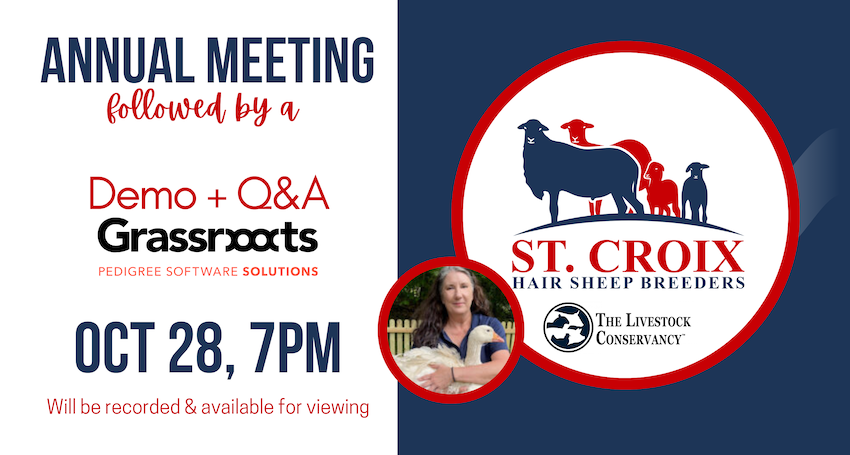
Members, please join us for the 2023 Annual Meeting on October 28th at 7:00pm Eastern via Zoom.

Your Board of Directors has been very busy this year and we are excited to share a recap of our activities, a financial report, and current projects. We will be joined by Jaye Ray from The Livestock Conservancy, who is our new registrar. Jaye will provide a full demonstration of how to use the Grassroots System to manage your flock. We will spend the last portion of the meeting in a Question & Answer Session with Jaye and the Board of Directors.

Meeting Agenda

  • 7:00pm – Welcome & Introductions
  • 7:10pm – Annual Reports
  • 8:00pm – Demonstration of Grassroots System
  • 8:30pm – Question & Answer Session

Register Now for the Meeting

Please register to attend the annual meeting. Registration is free. Have your member identification number handy. If you aren’t sure what that is, please contact us. After you register, you will receive an email with the link to join the meeting online. Please log in at least 5 minutes early to make sure you have no technical difficulties.

The meeting will be recorded and shared so that if you are unable to attend, you can still access the information.

Register Now

Posted in Annual Meetings, News Tagged Grassroots, meeting

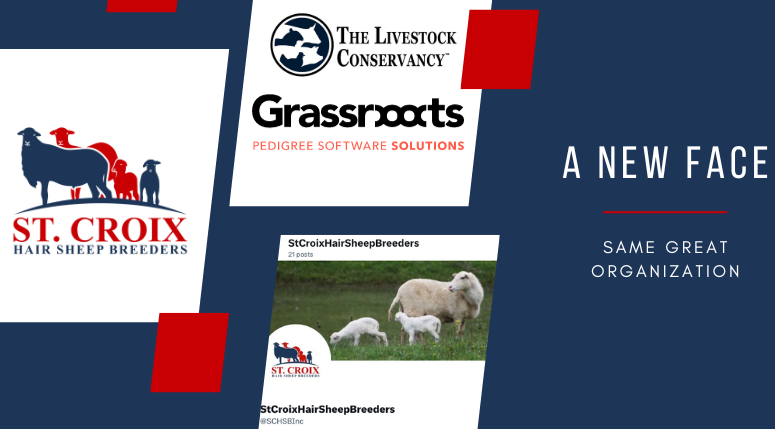
Welcome to the New Face of SCHSB

Posted on September 30, 2023October 1, 2023 by Treasurer Treasurer
Welcome to the New Face of SCHSB

Your SCHSB Board of Directors has been hard at work these last few months to create a new face for the organization. We have a new registrar, logo, website, forms, phone number, and social media channel.

New Registrar & Updated Forms

When GLM announced they will be closing at the end of 2023, the Board had to work quickly to find a new service provider. We are pleased to announce that we selected The Livestock Conservancy (TLC) as our new registrar. TLC uses the Grassroots Systems software and supports to manage all our data. 

Members will receive packets in the mail and via email within the next 14 days with instructions for logging onto and using the Grassroots system, and copies of all our updated forms. You will notice that the board increased membership dues to $25 and registrations/transfers to $8. These increases are necessary for the financial stability of the organization.

Face Lift for the Website

The Board has discussed updating the website for at least two years. Because our web admin would need to update all our links to the registry and adjust several related pages, the Board decided it was time to move forward with a new website. We secured services with Dream Catcher Connect in Charleston, WV, who will now serve as our web admin. The new site is clean, modern, easy to navigate on mobile devices, and will include timely news and events.

Fresh Logo

We also felt that this was the perfect time to update our logo. We chose to do this for several reasons. First, doing so will help people more easily discern between SCHSB and SCHSIA. The two logos were very similar and this added to confusion about which organization was which. Second, our previous logo was outdated. It was time to create something that is fresh and more adaptable to various uses. Finally, we could find no high-resolution version of the old logo, which prevented us from creating various print products, such as banners, shirts, posters, etc.

We feel the new logo is an excellent representation of our organization. It highlights our breed’s majestic ram while honoring the maternal traits our ewes offer that are the backbone of the breed. The colors signify the unique, American history of the breed.

New Ways to Communicate with Us

We have obtained a permanent, official phone number for SCHSB. That number is (458) 240-3499. Callers are asked to state their name before being routed to our secretary or designee. The secretary can access any voicemails you leave and can also interact with you via text message using the same number.

Finally, we have created a X (Twitter) profile for SCHSB. If you use X (Twitter), we hope that you will find us @SCHSBInc and follow our channel for news and updates. Our community of breeders has always engaged in lively discussions about our sheep, and it’s important that we facilitate communication on multiple platforms.

Posted in News Tagged forms, Grassroots, Livestock Conservancy, logo, phone, registrar, website

Calling All Artists! We Need a New Logo

Posted on June 16, 2023October 1, 2023 by Treasurer Treasurer
Calling All Artists! We Need a New Logo

Hello members! Are there any logo designers out there? We have decided that it is time for our organization to update its branding. We would love to use ideas from our membership. All are invited to submit logo ideas for consideration to this email address. The deadline for submissions is July 5, 2023. Good luck!

Posted in News

We Want You on Our Board!

Posted on June 16, 2023October 1, 2023 by Treasurer Treasurer
We Want You on Our Board!

The Board of Directors of the St. Croix Hair Sheep Breeders, Inc. is always interested in new and varied voices joining the board. There are several engaging, important projects going on (the Genetics Project for one!). If you are interested in participating as a director in the exciting decisions being made, or in finding out what the commitment to serve as a director means, please contact any director and get the details. The next election is not for more than a year – time will go fast but you’ve got time to investigate and think this over!

Posted in News Tagged Board

Hey! Hay!

Posted on June 15, 2023October 1, 2023 by Treasurer Treasurer
Hey! Hay!

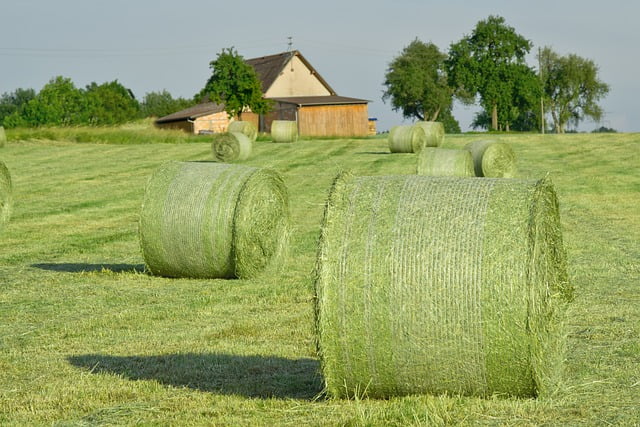
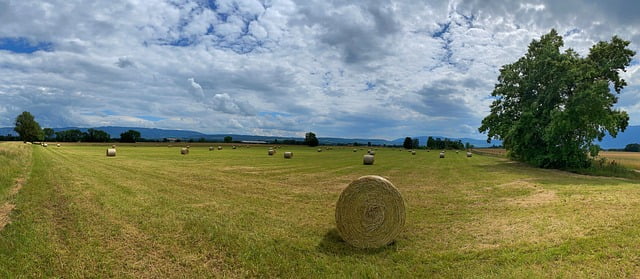
It’s hay season, everyone! While not everyone feeds hay in winter, many of us do, and this is the time of year that we start purchasing and storing hay. Some of our directors would like to share their hay feeding practices.

Elizabeth Hernandez, West Virginia

We feed mixed grass hay in square bales from a local farmer. We have repurposed metal hampers that we use for feeders while they are in the barn. We have a large hay feeder (I’m at baseball, it has the bottom ‘tray’ and has metal panels in a ‘V’ shape. I don’t know what it’s actually called) for our barn lot that we restock as needed.

Ryan Ridgeley, Michigan

We are feeding strictly grass this year hopefully all the way through winter. We already have a drought again, but we’re leaning on the preparations we’ve made to make it through on grass. We will have hay for emergencies if the snow gets too deep or if the drought is so severe that the grass doesn’t survive.

Crystal Criswell, Ohio

I feed mixed grass hay in round bales that I buy from a local farmer, usually from his 2nd cut. I found a used Sydell collapsible bale feeder and it is my favorite, but I also have two of the Premier1 big bale feeder panel sets (also secondhand). I put a pallet down on the ground and set the bale on its end on top of the pallet. Then I set up the feeder panels around the bale. I move the location a bit after each bale to prevent over-compaction. I also have a few square bales ready for feeding the ewes in the lambing jugs for 24 hours after lambing.

Tamara Lambdin-Abney, Kentucky

We cut our own hay; a mixed grass with red clover. We square bale and store in a barn and hay shed on wooden pallets, We feed hay and lamb grower in winter months and in jugs for ewes with their lambs for a couple of days. We also feed hay in the spring on new grass to help with any scours. We generally put it on the ground next to any feed/ minerals. (It’s a bit wasteful but good to either leave for them to lay down on or add to the garden.)

Lori Marion, Oregon

We had more rain at just the right times this year, for much better grazing right into the coming winter we hope.  When we have to feed hay in winter, we have feeders built with Premier 1’s plans.   The rams have repurposed halves of water pressure tanks to keep it off the ground.  My favorite (and the sheep’s) is grass with about 20% alfalfa, but we have fed straight grass hay and some grain hays with that.  Rye is their least favorite- it’s like kids eating oatmeal- they’ll eat it if they are really hungry, but they’ll never overeat!

Posted in Sheep Care Tagged hay

Make Your Best Hay

Posted on June 14, 2023October 1, 2023 by Treasurer Treasurer
Make Your Best Hay

Copied with permission from the Ohio State University Sheep Team

Mike Rankin, Hay and Forage Grower managing editor (Previously published in Hay & Forage Grower: May 11, 2021)

There’s never been a haymaker who couldn’t improve on their craft. The opportunities to enhance forage yield, quality, and persistence are nearly endless. Whether you’ve already started cutting or are still waiting, Amanda Grev offers this bevy of suggestions in the University of Maryland’s Agronomy News to improve this year’s hay quality ledger.

Harvest at the correct maturity stage
“The single most important factor affecting forage quality is the stage of maturity at the time of harvest,” notes the extension pasture and forage specialist. “This is especially true in the spring when forages are growing and maturing rapidly.”

Target the onset of cutting at the boot stage for grasses or late bud to early bloom for legumes. For legume-grass mixtures, base your cut-time decision on the maturity of the grass, which usually mature earlier than legumes in the spring.

Cut early, wide, and high
In humid regions, maximize curing time by mowing in mid- to late-morning after the dew has dried off. This will allow for more drying time before sunset. Grev notes that maximizing exposure to sunlight and wind will result in faster dry down and reduced plant respiration during hours of darkness.

“When mowing, set the mower to make as wide of a swath as possible, ideally at least 70% of the cut width,” Grev writes. “Maximizing the swath width shortens the wilting time by exposing a larger portion of the forage to direct sunlight, which leads to faster drying and preserves more digestible dry matter.”

She also recommends paying attention to cutting height and avoid cutting hayfields too close. For alfalfa, leave 2 to 3 inches of residual. Cool-season grasses generally require no less than a 4-inch cutting height.

“Not only will this result in improved stand persistence, earlier regrowth, and sooner subsequent cuttings, but the stubble will help to elevate the swath and promote airflow and rapid drying,” Grev explains.

Monitor moisture
Ted or rake forage above 40% moisture; this helps to reduce leaf loss, especially for legumes. Make sure rakes are properly adjusted to avoid picking up soil. Using rakes that handle the hay gently or slowing the speed of the rake are also ways to further minimize leaf loss and maintain forage quality.

Bale hay at 15% to 18% moisture to inhibit mold growth and reduce heating. Hay that is too wet — above 20% moisture — is prone to excessive heating and is subject to having high concentrations of heat-damaged, indigestible protein. Hay that is excessively dry will have greater leaf loss, which reduces forage quality.

Time cuttings
“Appropriate timing includes not only harvesting at the ideal forage maturity but also timing your cutting schedule for optimal growth based on seasonal weather conditions,” Grev notes. “For example, completing the first cutting in a timely manner allows time for adequate regrowth and a good second cutting prior to the onset of the hot summer months. A nitrogen application (for grasses) following first harvest can help with this by stimulating forage regrowth.”

Grev recommends allowing cool-season hayfields to go into the summer with at least 5 to 6 inches of regrowth. Doing so will provide shade to the plant crown and moderate the soil surface temperature, reducing soil moisture losses.

Fall hay cuttings need to be scheduled to allow stands enough time to regrow and replenish root carbohydrate reserves prior to winter dormancy.

Feed the crop
Quality forage can’t be achieved without a sound soil fertility program. Grev suggests that a sound forage system entails providing adequate nutrients to the crop while also monitoring soil pH, soil compaction, nutrient removal rates, and overall nutrient status.

“High-yielding cuttings of hay remove substantial amounts of nutrients from fields, making a balanced fertility program essential for optimizing hay production,” Grev says. “Take the time to soil test and apply nutrients and lime according to soil test results. Avoid using “complete” fertilizers like 10-10-10, which commonly overapply phosphorus and underapply potassium.”

Keep it covered
Finally, Grev cautions to preserve forage yield and quality during storage. Store hay off the ground and preferably under cover. Weathering losses are largely the result of hay bales wicking moisture from the ground.

Posted in Sheep Care Tagged hay

Posts navigation

Older posts
Newer posts

Recent Posts

  • New! Place a Classified Ad to Sell St. Croix Sheep or Equipment
  • The 2025 Annual Meeting is January 29, 2026
  • Important Update about the Grassroots “For Sale, Hire or AI” Posts
  • Registration Tip
  • Symposium was a Success!

St. Croix Hair Sheep Breeders

 458-240-3499

 Contact Us