• Grassroots Login
  • Join Now
  • Find St. Croix


Skip to content
  • Home
  • About the Breed
  • About SCHSB
  • News/Events
  • Contact Us
  • Classifieds
  • Shop

Author: Lori Marion

Important Update about the Grassroots “For Sale, Hire or AI” Posts

Posted on November 23, 2025November 23, 2025 by Lori Marion

Posts of sheep for sale in the Grassroots “For Sale” listing will be removed when they are older than 4
months. You are welcome to re-post the animals for sale if they are still available. This will help keep
the list up to date. Buyers won’t be frustrated by posts of sheep that aren’t available, and you won’t be
contacted about sheep that are no longer available. Questions? Please contact a director!

On another note, classified ads reached via the SCHSB website is in the final testing phase, and will soon
be available to all members! Several roadblocks were resolved that preserves member contact
information security, while still allowing for traditional classified ads. Look for more information soon on
how the classifieds can be posted.

Posted in News Tagged for sale

Registration Tip

Posted on November 19, 2025November 23, 2025 by Lori Marion
Registration Tip

Here is a registration tip for our members. As the Owner-of-the-Dam-at-Time-of-Lambing (ODTL), you are the only person who can register the lambs. If you sell those lambs when they are unregistered, including Birth Notified only, the buyer cannot register the lambs, and hence cannot transfer them to their own flock.

This is because you, as the ODTL, are the only person with the knowledge of the lambs’ correct dam
and sire. You have the judgement to evaluate whether that lamb meets the breed standard for registration and your own farm standards. Once these lambs are registered, you are the only person who can transfer the lambs to the buyer using Grassroots, which is the most convenient method.

Once a lamb is Birth Notified, you can register and transfer at the same time, paying two transaction fees; one for the registration and one for the transfer. Make sure you know the correct name and address for the buyer and their membership number if they have one. As the seller, you can determine if the fees are built into the price of the animal, if you wish to charge the buyer for the transactions separately, or if you will cover the registration and/or transfer.

You can still use the old system of mailing in paper registration and transfer applications along with payment, or giving a signed registration document to the buyer to send it in. However, it’s more difficult and more likely to result in delays than doing the registration and transfer online using Grassroots.

Registering St. Croix sheep is critical to the growth of the breed, and to maintaining the full gene pool of
the breed. Be part of the registration chain that keeps the St. Croix breed growing and thriving!

Posted in FAQ Tagged registration tip

Survey of Active St. Croix Sheep is Happening Now!

Posted on November 6, 2025November 23, 2025 by Lori Marion
Survey of Active St. Croix Sheep is Happening Now!

A survey to help members clean up their flock lists is happening now on Grassroots. From November 1, 2025 to April 30, 2026, the first time you log in to Grassroots, you will be shown a list of your active flock.

Please take the time to mark any animals that have died, or that have been sold commercial (sold to ZZZZZ). Click ‘Submit’ to return to your flock listing. You will only be asked to do this ‘survey’ the first time you log in during this period, but it’s always a good idea to keep your flock list up to date. There is never a fee to mark an animal as dead, or as sold commercial.

Taking the time to do this will help maintain an accurate census of active registered St. Croix sheep – an
important marker of the growth of the breed across the country.

Posted in News Tagged flock survey

Foiling Predators

Posted on March 11, 2025 by Lori Marion
Foiling Predators

Predators and internal parasites are two of the largest causes of sheep and lamb losses. St. Croix sheep are known for having a leg up on resisting the effects of parasites, but all sheep are vulnerable to predators. In the USDA’s 2020 report, 32% of losses of mature sheep are due to predators, and 40% of
all lamb losses. There are many methods for minimizing sheep losses to predators. No method is 100%
effective, but choosing the best methods for the situation will yield the best results.

Predators come in many forms – wild, feral and domesticated, 4-footed and winged, solitary and
cooperative hunters. Canines are overwhelmingly the most common predator of sheep, accounting for
47% of all predator sheep kills. Dogs are the next most common, with 34%. Bears, mountain lions, fox,
wolves, bobcats, eagles, hawks and even ravens and vultures round out the list of usual suspects for the
remaining 19% of losses.

Preventing the loss of the first sheep can be most effective in discouraging further losses. Many experts
feel that once a predator has killed and eaten sheep or lamb, it’s more likely to do so again as predators
learn from experience and from one another. Sometimes killing the predator only allows a new predator to move into the now-vacant territory. State or federal laws protect many predators so ranchers cannot legally kill them without obtaining a permit to do so.

When attacks do occur, the sheep owner rarely sees the attack occur,. But each predator may leave clues to their identity on the prey and in the area. The more the owner knows about what to look for and the earlier the signs are noted, the more useful info can be learned. New or different deterrents may be
needed to discourage that predator. Some resources are below to help with predator identification and
management.

Identifying the predators that are likely to be present in your area is a starting point for choosing cost-
effective methods of deterring them. Integrated predator management means combining the most effective means of deterrence for the predators in your area.

Predator Resources:

  • Distinguishing stillborn lambs scavenged by coyotes from lambs killed by coyotes or by dogs.
  • The Internet Center for Wildlife Damage Management can help the livestock owner identify other
    predators.
  • USDA/APHIS’s Wildlife Services provides information and services by state that can be accessed by calling 1- 866-4USDA (866-487-3297).
  • Data on sheep predators and losses are from the USDA’s 2020 National Animal Health Survey of sheep. The next NAHMS sheep survey was conducted in 2024, and results should be released in 2025.
Posted in News

Genetics Project Update

Posted on August 9, 2024 by Lori Marion
Genetics Project Update

The SCHSB Genetic Fingerprint Project is complete! The findings of the research were presented via the “St. Croix Sheep Genetics: Discoveries and Possibilities” webinar in February of 2024. The project was led by the SCHSB Board of Directors, Dr. Brenda Murdoch from the University of Idaho, and Dr. Phil Sponenberg, Technical Program Director for The Livestock Conservancy. The work confirmed that the St. Croix breed clusters distinctly and separately from all other hair sheep breeds. Therefore, it is possible to employ genetic testing to identify the breed. Additional molecular testing revealed that the sample pool of St. Croix sheep was genetically diverse and free from common genetic diseases. This is good news and a great start!

Genetics Committee

A Genetics committee consisting of Board members (Lori Marion, Crystal Criswell, Amy Wheeler) and volunteer association members (Scottie Greene, Jovi Larson, Matt Marlowe, Tara Seltz) held several meetings. The committee considered the best usage of genetic technology to protect genetic diversity in the breed and position producers for future success. 

Some of the ideas considered were as follows:

  • Develop a program using the current DNA profile to allow readmission of ‘purebred but unregistered St. Croix sheep’ into the registry using a careful vetting process along with acceptable DNA testing.
  • Increase the confidence of the St. Croix DNA profile by testing known crossbreds against it.
  • Obtain samples from untested populations of St. Croix sheep to ensure adequate representation of the breed to the best of our ability.
  • Invite the University of the Virgin Islands to test known purebred sheep from the island to compare against the U.S. mainland flock. 
  • Evaluate Virgin Island sheep for possible importation of semen and/or embryos to broaden and deepen the genetic pool of our breed.
  • Continue to actively seek research opportunities involving St. Croix sheep

The next steps will be to compile a final report of the project and begin careful exploration of the ideas generated by the genetics committee.  All considerations are subject to board approval.

Committee Chair Appointed to Board of Directors

Tara Seltz, who has been a member of SCHSB for 2018, played an active role in the Genetics Committee. The SCHSB Board of Directors voted to appoint her as a Director to fill one of the open seats and to Chair the Genetics Committee for the remainder of the project. Please contact Tara Seltz with any questions, concerns, or if you would like to participate in the project.

Posted in Genetics, News

Weaning Management: Weaners and Weanees

Posted on July 30, 2024July 30, 2024 by Lori Marion
Weaning Management: Weaners and Weanees

At Shasta Ranch, weaning takes place at 10 -12 weeks – about 70 -84 days old. We remove the ewes from the lambs, who remain in their familiar area – a large pen/pasture with shelter. The ewes are moved to a larger pasture, rejoining the remainder of the flock. We breed groups of about a dozen ewes at a time, so we are weaning lambs every 2 1⁄2 months.

By 10 -12 weeks of age, milk production is dropping. Maximum milk production is at 4-6 weeks. The newly-removed ewes have clean, dry bedding, and we watch closely for any signs of mastitis as milk production slows further. They have a lower quality diet for about a week before weaning, and then for 2
weeks after to help reduce milk production.

Lambs who are 10 -12 weeks old are spending less time with their dams and more time with their peers. It can still be a bit of a rough transition for both lamb and dam. We feed the a familiar, good quality feed ad lib, whether it’s grazing or hay, to ensure they have lots to eat. The lambs have an ‘auntie’ with them. She is an aged, non-productive ewe who has been with them since the lambs turned about 4 weeks of age. The mature ewe helps keep the lambs calm, leading them out to pasture, leading them to water, watching for predators, and returning to the shelter at tonight.

We observe the lambs closely for about 2 weeks, while they transition fully to a grazing/hay diet. We examine any lambs to identify problems, including the 5 point check for parasites or coccidia. When
we are sure the lambs are doing well without their dams, they are ready to go to their buyer and a new
place. They are ready to rejoin their dams in the main flock when they are fully weaned – sometimes 2
months or more.

Sheep 101 offers more information about different plans for weaning. Different things work for different operations. It’s a good idea to find what works for you, for your sheep
and for your market.

Posted in Sheep Care Tagged weaning

WANTED: St. Croix Sheep to Churn Butter

Posted on January 20, 2024June 3, 2024 by Lori Marion
WANTED: St. Croix Sheep to Churn Butter

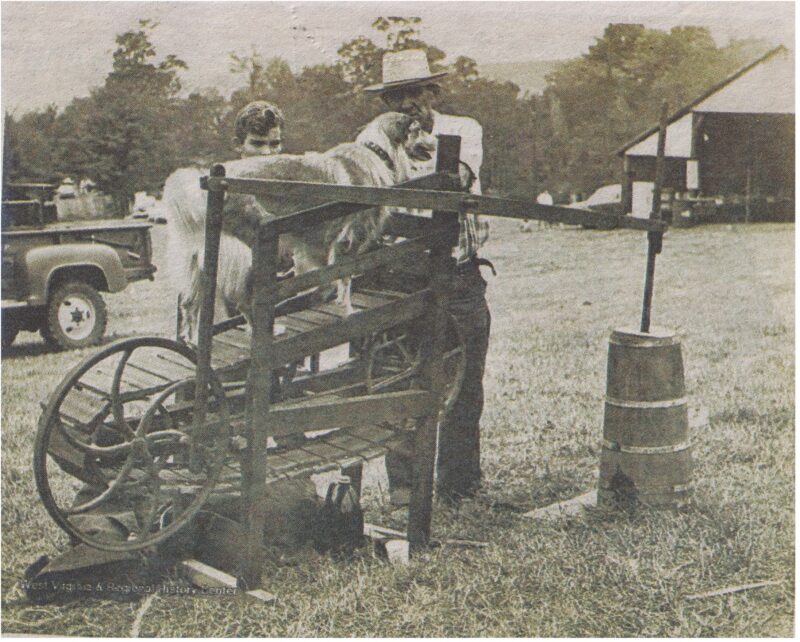
St. Croix sheep are primarily meat sheep, but they can do other jobs, too. They eat vegetation to reduce fire risk, to control invasive species or as organic weed control. They can produce milk for dairying and they can be great sheep to train herding dogs. And back in history at least, they could churn butter, too.

The Illustrated Catalogue of Agricultural and Horticultural Implements printed in 1857 by Tredwell and Pell, describes a butter churning machine, made of slats riveted to two india-rubber straps, forming a self-supporting platform on upon which the animal walks. The motion of the endless platform giving action to the forward drum, through it to a crank upon one end producing the necessary motion required to operate the ordinary dash churn.

“A sheep is found fully equal to a dog and the work is not hard upon either….sufficient to do all the churning for a large dairy”, the catalog says.

The Transactions of the New York State Agricultural Society in 1860 noted that: “Unquestionably, the power propelled by sheep is much the cheapest and most efficient. A sheep will churn two or three times a day, even in warm weather without inconvenience, and is much less expensive to keep than a dog as its food is mostly grass. Choose sheep that can stand the heat well, and are inclined to be mild in disposition. They soon learn to drink buttermilk, and grow large and fleshy.”

But if you prefer not to employ your St. Croix sheep churning butter, then there is always this:

“We have no doubt, as to their superiority over all others breeds as mutton sheep, their hardihood, and their unrivaled symmetry and beauty. No sheep is more ornamental upon the lawn or field in summer, none presents so singularly comfortable and contented an appearance, as with the quietness of its nature, it crunches the crisp dry hay among the snows of winter. Where even a few sheep only are kept, for the pleasant and legitimate pride of ownership, for the supply of the family table, we regard the St. Croix as the best sheep. (OK, it actually reads ‘Southdowns” not “St. Croix”, but the sentiment is the same!)


Posted in Dairy Tagged churn butter, dairy sheep

Lambing Info from Shasta Ranch

Posted on January 18, 2024June 3, 2024 by Lori Marion
Lambing Info from Shasta Ranch

There’s a lot of good, complete information on lambing available. At Shasta Ranch, we found information from Ontario Canada’s Ministry of Agriculture, Food and Rural Affairs, to be concise and helpful. The 3 documents below take you through lambing and caring for the lamb – and you can ignore the part about docking tails. Tail docking isn’t part of the breed standard for St. Croix sheep. The haired tail doesn’t accumulate manure or body fluids the way woolly tails can so fly strike is far less of an issue.

Assisting the Ewe at Lambing
Care of the Newborn Lamb
Hypothermia in the Newborn Lamb

Clipping

Some experienced shepherds have shared helpful tips learned over the years as well. If the lamb has a long or wet umbilical cord, or one that is still oozing blood, dental floss is a clean, easily available ‘string’ to have in your lambing kit. Tie the cord off a short distance from the body (2-3”), tightly enough to stop any oozing of blood, but not so tight that the dental floss cuts the cord off at the tie. Clip the cord and the ends of the floss just beyond the tie.

Dipping

Cords, tied and cut, or already short and beginning to dry, should be dipped in antiseptic solution to prevent ‘navel ill’ or ‘joint ill’ – a bacterial infection that enters through the navel, and into the body, making a young lamb very ill, often with leg joint swelling and pain. A common disinfectant is 7% Iodine. It kills bacteria quickly, and after it dries, forms a protective barrier, offering some residual antiseptic protection. But 7% iodine can be hard to find due to regulations on its sale. It is also irritating to the skin around the navel, causing more skin openings for bacteria to invade. It can be messy to use, too.

For something more available, less irritating to lamb skin, less messy, and similarly effective at disinfecting the navel, research on calves gives some ideas. The most commonly available is 2% chlorhexidine, a disinfectant found to be as effective as 7% iodine. The downside is that it may not assist with drying the cord as much as iodine does. For more information, see Navel Dips for Lambs and Kids.

Good luck with your lambing. It is one of the best parts of raising sheep or one of the hardest, depending on how things go, but definitely one of the most exciting!

Posted in Sheep Care Tagged lambing

Genetics Project Update: Analysis Complete

Posted on October 5, 2023June 3, 2024 by Lori Marion
Genetics Project Update: Analysis Complete

The SCHSB Directors have worked for over year on a Genetics Project for the breed. We partnered with Dr. Brenda Murdoch at the University of Idaho. She worked to determine if St. Croix sheep can be differentiated from other breeds using genetic testing. Dr. Murdoch further evaluated if both medium-density (60K) and low-density (Flock54) marker panels would generate equally valid results.

The Process

Fifteen (15) SCHSB members from across the country volunteered to obtain tissue samples from their sheep. They selected sheep that represent a variety of bloodlines and phenotypes (shedding, color, muscling, size, fast growth, slow growth, scurs, behavior, eye color, etc.). Several of the sheep express color to varying degrees. It was important to include this variety to ensure that the data collected adequately represents the breed as a whole.

In all, we sent 90 samples to Dr. Murdoch. Of those, 78 were analyzed and some late-arriving samples will be added soon. Dr. Murdoch’s team obtained genotype data from the 78 St. Croix sheep samples using both the 60K and Flock54 marker panels. The team compared our sheeps’ genotypes to those of three other hair breeds (Katahdin, Dorper, Barbados Blackbelly) and several wool breeds (Suffolk, Rambouillet, Targhee, Polypay, Suffolk x Texel, Targhee x Polypay, and wool sheep from the Sheep Discovery Center).

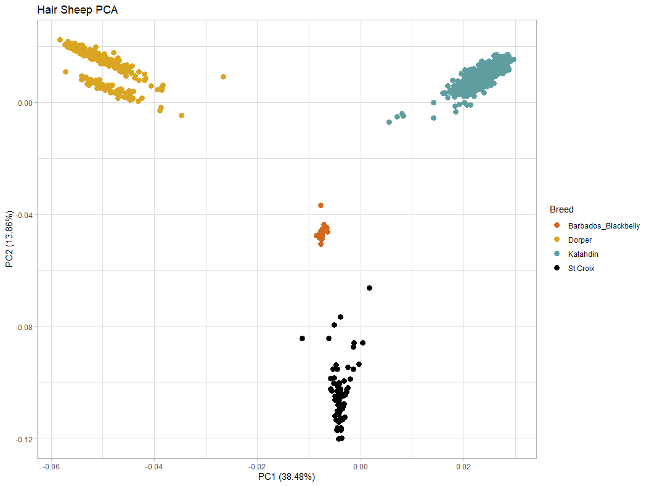
Figure 1 - 60K PCA Plot
Figure 1 – 60K PCA Plot
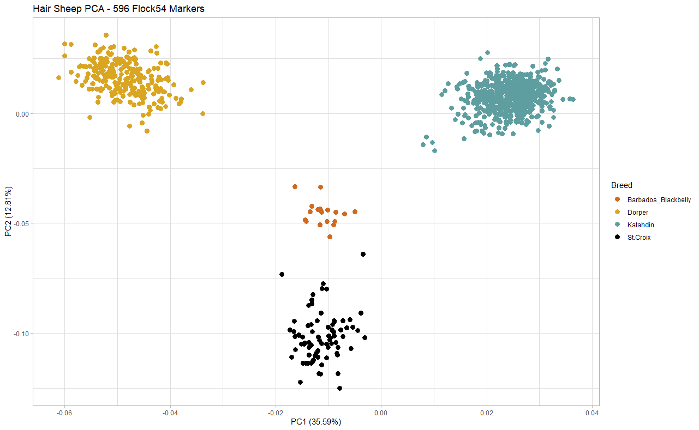
Figure 2 - Flock54 PCA Plot
Figure 2 – Flock54 PCA Plot

The Findings

Both the medium-density (60K – see Figure 1) and low-density (Flock54 – see Figure 2) panels produced results that clearly clustered St. Croix sheep (the black dots) in such a way that they can be differentiated from other breeds. Barbados Blackbelly sheep (the dark orange dots) clustered closest, but still exhibit clear separation from the St. Croix sheep in this sample. Dr. Murdoch is confident that both panels can be used to confirm the genetic conformity of a sheep believed to be a St. Croix. There may be some individual Barbados Blackbelly or St. Croix sheep that are so genetically similar that the Flock54 panel may not be adequate without additional statistical analysis.

Next Steps for the Genetics Project

The SCHSB Directors have formed a Genetics Committee to discuss how we will use these findings to meet our central mission; preserving the breed. The committee includes members who participated in the project and expressed an interest in serving. We will consult with experts in genetics and breed conservation.

The Genetics Committee will meet to explore options and make recommendations to the SCHSB Board of Directors. We will consult with the experts throughout the process. The Board will schedule a webinar early in 2024 to help all members fully understand the information.

We encourage members to ask questions and share your thoughts on this matter by contacting us.

Posted in Genetics, News Tagged Flock54, Genetics, Murdoch, Sponenberg

Recent Posts

  • New! Place a Classified Ad to Sell St. Croix Sheep or Equipment
  • The 2025 Annual Meeting is January 29, 2026
  • Important Update about the Grassroots “For Sale, Hire or AI” Posts
  • Registration Tip
  • Symposium was a Success!

St. Croix Hair Sheep Breeders

 458-240-3499

 Contact Us